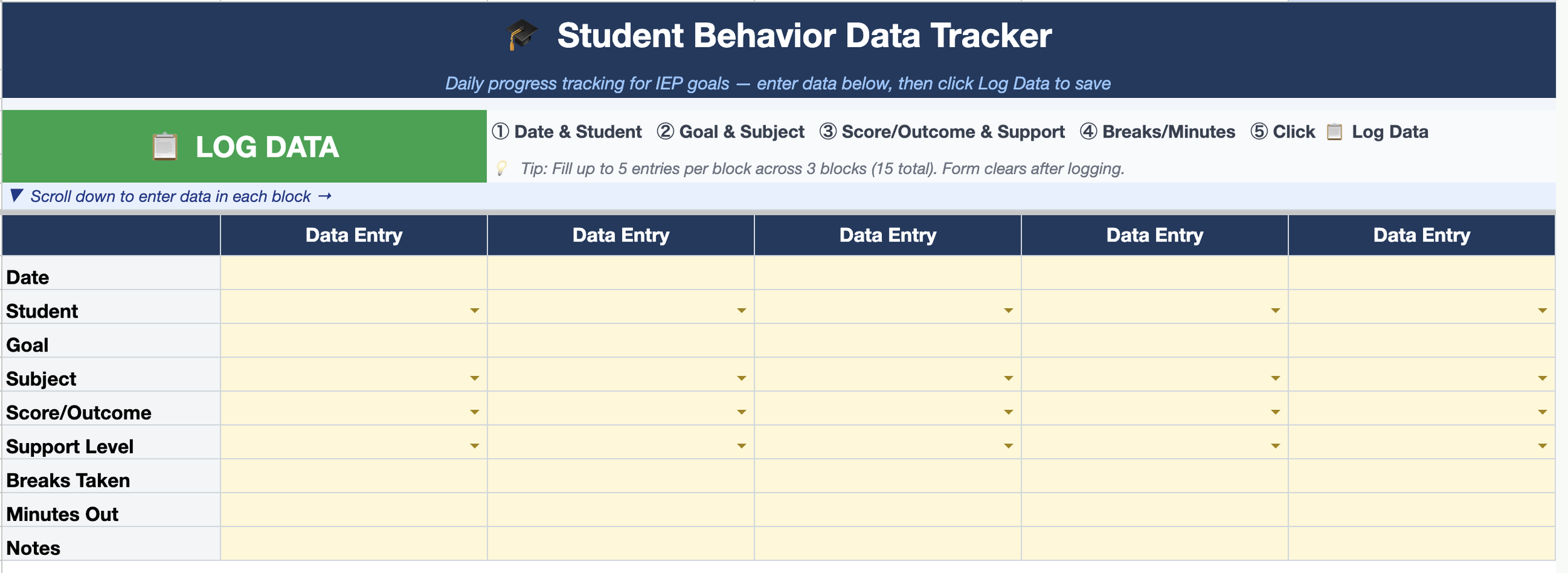
Data Collection and Management System

Click on the image above to navigate to a Demo of the Data Management System

*Please note, this is a “living” resource and I am continuing to add repairs and refinements

This project is a Google Sheets and Apps Script data tracking system built for our school's K–3 self-contained Communication Program. It automates IEP goal tracking, calculates cumulative performance in real time, and generates printable summary reports per student. I stepped into this project not knowing how to help or what was possible. I have an automated system in my own classroom, a digital economy, where student bank accounts, jobs, salaries, and transactions all ran through Google Sheets. I knew what the technology could do, and that's what helped me here. What started as a small ask about organizing academic data, became a full redesign of the program's data infrastructure, and is now in active daily use for both academic and behavioral data.

Growth Through Challenge

You can't build the right system until you understand the real problem

The deeper I got into this project, the more I understood that the data problem was downstream of a design problem. The original system asked one teacher and instructional assistants to collect data on every student, every goal, every day. That is not a sustainable system. The moment that made this undeniable was spending hours inputting hard copy data into the district's existing tracking tool, only to discover through that process that the data itself lacked consistency in scoring, in collection, and even in how goals were written on the paper trackers. The problem wasn't that data hadn't been entered. The foundation underneath it needed to be rebuilt. The biggest challenge we then faced before a single line of code for this system was written, was figuring out how to create something that was both comprehensive and simple enough to actually use. Simplicity wasn't a compromise. It was essential to allow data to be consistent and reliable. The teachers has been so relieved to have a thought partner through this process and loved the idea of switching from a 1–4 rubric to a yes/no outcome. Adding an independence level to that yes/no outcome also meant we were trading false precision for real consistency. Rotating data collection by goal type across the week, rather than attempting everything daily, meant treating data collection as a structured practice rather than a reactive one.

What made this project feel like an onion was that every layer we solved revealed another layer underneath. As mentioned previously, she had originally reached out asking for help with academic data tracking. As we worked together, she asked if I would mentor her more broadly because she wanted to have confidence around data and systems, the kind that would serve well in IEP meetings and conversations with parents. She was so willing and eager to try something new to bring more structure and stability to her program, and that thought process is admirable because it comes down to doing what’s best for kids. Throughout this journey, I have watched her and her assistance become owners of their data, coming up with even more ideas on how to enhance their program’s capacity. We have continued making necessary changes as the program staff began to use it, and now we are several iterations past where we started.

This process taught me something I will carry forward. The most well-designed plans fail if the person using it doesn't see themselves in it, and the more collaborative a project is, the more ownership and investment that follows.

Leadership Strengths // Modeling

Sustainable systems make consistency possible

One strength that has been affirmed through this project is my ability to see operational problems as instructional problems in disguise. The data wasn't being collected consistently because the system made consistency nearly impossible, not because the teacher lacked commitment. Recognizing that distinction shaped every decision I made. The system reflects it. Drop downs auto-populate by student so only their active goals appear. One click logs all entries and clears the form. Each student has a live performance tab and an IEP-ready summary report with goal progress, support level trends, and a class-wide comparison by goal type. What the teacher used to calculate manually and record inconsistently now happens automatically, giving her time back and giving her something defensible to bring into every IEP conversation.

Watching the special education program’s staff become excited and seek out more support or clarification when something isn’t working has been incredibly inspiring to be part of.

Reflective Revisit // Next Steps

The slower timeline wasn't a setback, it was the foundation

If I could revisit this project with one thing, it would be foresight, though I'm not sure it was ever truly available to me. The full scope of what was needed only became visible through the work itself. I spent weeks in the fall inputting hard copy data into the district's existing tracking system, only to realize that the data lacked consistency in scoring, in collection, and even in how goals were tracked. The problem wasn't that data hadn't been entered. The foundation underneath it needed to be rebuilt. You can only see that from the inside. I was also mentoring a student teacher that fall and took that responsibility seriously, which meant this project moved at the pace it needed to rather than the pace I might have pushed for otherwise. Looking back, the slower timeline was probably right.

Looking forward, the work I am most focused on is scaling this kind of thinking beyond a single classroom. This tool was built for one teacher and one program, but the problem it solves is widespread. Special education teachers are leaving the profession at alarming rates, and unsustainable systems are a meaningful part of why. My goal is to bring this system to our district's director of special education and make it available to any teacher who needs it. Nobody should have to build infrastructure from scratch just to have work-life balance. I want to build the leadership capacity to identify those gaps at a program level and create the conditions where teachers can name what isn't working before it drives them out.

TSPC Standards Alignment

Each project in this portfolio is intentionally connected to Oregon's Principal License Standards, demonstrating how my practicum experiences built real leadership readiness across multiple domains.

By clicking the link below, you’ll be directed to the government website for a full description of each standard of practice.

  • I kept watching a teacher drown in a system that was never going to work, no matter how hard she tried. When data collection is designed around what is actually sustainable for one human being to do consistently, it stops being a compliance task. It becomes something a team can build a program around.

  • Students in self-contained special education programs can be among the most underserved in any building, and inconsistent data is part of how they stay that way. The equity problem doesn't stop at data collection. It shows up in IEP meetings too, where families receive a firehose of information in language they didn't train for and are expected to be partners in decisions they can barely follow. Most caregivers won't ask for clarification a third time. Many leave without truly understanding where their child stands. The automated summary tab changes what a teacher can bring into that room. A color-coded progress report with charts and goal-by-goal breakdowns, generated in one click, gives families something they can actually read, reference, and return to. Accessible communication should not require extra hours from a teacher to make it happen.

  • A teacher who can walk into an IEP meeting with clean data, clear trends, and a visual summary of every goal is a different kind of advocate for their students. That is what this system makes possible. Getting the data infrastructure right changed what this teacher is able to say and do on behalf of kids.

  • Special education has one of the highest teacher turnover rates in the profession, and unsustainable systems are a meaningful part of why. Giving this teacher her time back, and watching her staff go from dreading data collection to owning it, is what keeping good people in hard jobs actually looks like.

Next
Next

School + Family Communications